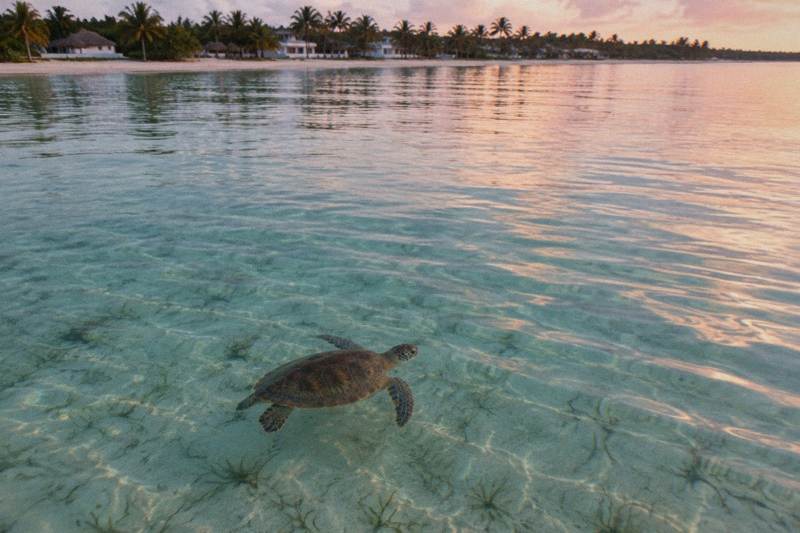
Are Sea Turtles Friendly? What Happens In The Water In Akumal
Sea turtles in Akumal Bay are wild animals that tolerate calm snorkelers at a distance. This guide explains what friendly actually means here, the 3 meter and 2 minute rules, and why guided tours keep turtles and swimmers relaxed.
How Sea Turtles Behave Around Snorkelers
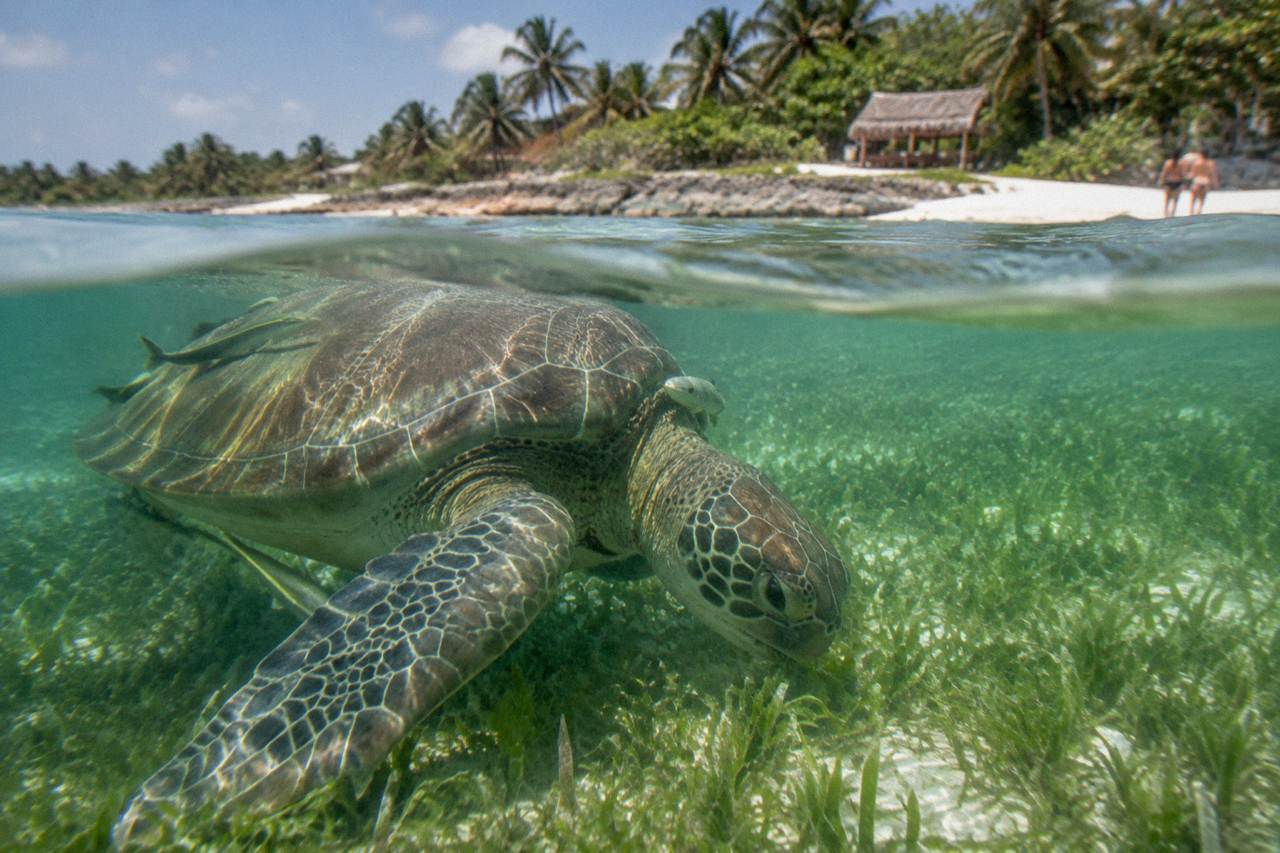
Sea turtles in Akumal Bay are wild animals, not tame ones, and friendly is the wrong word for what they offer: tolerance. A resident green turtle will keep grazing on seagrass while a calm, distant snorkeler floats above, and it will leave the moment someone crowds it. Operators describe resident green turtles feeding in the bay year round, reported, not promised. If you want to meet that tolerance under the calmest conditions, the month-by-month guide to turtle conditions in Akumal explains how water clarity, crowds, and the nesting season shape the calendar.
That tolerance is exactly why Akumal works as a turtle destination. The turtles here are not fed, trained or attracted by people. They come for the seagrass meadows on the bay floor, and they stay because the bay is a federally protected refuge where the feeding zones are marked with buoys and visits run on a strict schedule. Snorkelers are the guests in that arrangement, and the whole system, guides, vests, short fins, group caps, exists to keep the interaction boring for the turtle. Boring, it turns out, is what lets visitors season after season watch a wild animal eat its lunch a few meters away.
The nervous snorkeler often pictures a bite, a charge or a panic. What actually happens in the water is quieter: a turtle surfaces for air with a loud exhale, returns to the seagrass, lifts its head occasionally to check its surroundings, and moves off at an unhurried pace when it has had enough of an audience. No reported incident in the bay describes turtle aggression toward a swimmer, and no fresh source describes a bite. That absence is not luck. It is the product of rules that assume the animal is wild and set the encounter on its terms.
If the question behind the question is whether a guided tour is safer and easier than going alone, the answer is that a guide manages the distance, the timing and the group size for you. The Swim with sea turtles tour by Akumal Ecological Guides, from $45 per person, rated 4.6 from 454 reviews, is built around that: gear, beach entry, fees and activity insurance in one price, with the swim run as a guided tour. For a first-timer who wants photos without chasing anything, the Akumal Beach VIP line with GoPro photos, from $34 per person, 4.6 from 410 reviews, does the same job with a camera included.
Do Sea Turtles Bite Or Attack Snorkelers?
No source for Akumal Bay records a turtle biting or attacking a snorkeler, and the behavior described by operators is avoidance, not aggression. A turtle that feels crowded swims away, dives or angles its body away. The real risks in the bay are human ones: standing on coral, blocking a surfacing animal, or exhausting it by pursuit.
A sea turtle's mouth and jaw are built for seagrass, sponges and crustaceans, not for defense against tourists. Green turtles, the species most often seen grazing in Akumal, are herbivores as adults. Loggerheads, which also nest on these beaches, crush hard-shelled prey. Hawksbills work sponges off the reef. None of the three treats a floating human as prey, and none of the fresh reporting gathered here describes a defensive bite in the bay. The absence matters because it is consistent across a refuge that has run guided swim circuits for years under federal rules.
What the rules do describe, plainly, is the behavior that stresses the animal. The federal protection programme for the Bahia de Akumal refuge prohibits touching, feeding, chasing, harassing or removing wildlife, and prohibits standing on or touching coral. Those prohibitions are published in the Programa de Proteccion for the refuge, the same document that sets the circuit hours at 9:00 to 17:00 and the group cap at six snorkelers plus the guide. A turtle that is fed learns to approach boats and people, which ends badly for the turtle. A turtle that is chased burns energy it needs for mating and migration. Neither is a bite story, but both are harm.
So the reassurance for a nervous swimmer is twofold. The animal is not looking for a fight, and the encounter is structured so the animal never has reason to defend itself. Inside the buoyed turtle circuits, tourist swimming is only allowed with a certified guide, a mask and snorkel, short fins, and a life jacket that prevents total immersion, because the federal programme requires exactly that combination. Outside the circuits, an independent snorkeler in the bay is covered by different guidance, and the Centro Ecologico Akumal's own snorkeling guidelines treat a vest as advisable rather than compulsory. The scope matters, and it is worth reading the full breakdown in the Akumal turtle snorkeling rules guide.
Wondering whether this works for you? Guided tours keep everything within the rules without you having to memorize them.
What The Rules Ask Of You Around Turtles
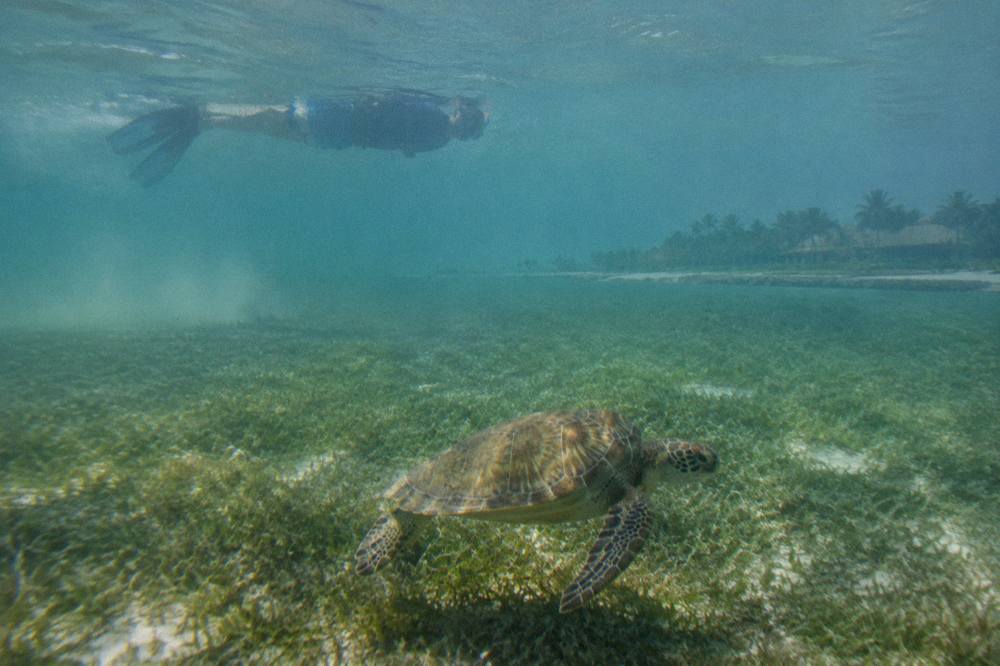
The core code is short: never touch, feed, chase or block a turtle, stay horizontal in the water, never stand on the reef, keep at least 3 m away, and watch any single turtle for no more than 2 minutes. Inside the buoyed circuits add a certified guide, short fins and a proper vest, with groups capped at six plus the guide.
Those numbers are not tour-operator marketing. The 3 m distance and the 2 minute viewing limit come from the Centro Ecologico Akumal's published snorkeling guidelines, which also ask snorkelers to stay inside the bay, never dive down or swim underwater, and wear a sun-shirt or biodegradable sunscreen rather than coating skin in chemicals before entering a refuge. The CEA guidelines page spells out each point, and the federal programme adds its own layer: only biodegradable sunscreen is allowed in the Bahia de Akumal subpolygon, full stop. A rash guard solves the problem better than any bottle, and no sunscreen brand can be named as approved here.
For a reader trying to picture all of this at once, the rules sort neatly into what you do, what you wear and what you bring:
| Rule | What it means in practice | Source of the rule |
|---|---|---|
| No touching, feeding, chasing or blocking | Let the turtle choose the distance and the exit | CEA snorkeling guidelines |
| 3 m minimum distance | Never close the gap yourself, even for a photo | CEA snorkeling guidelines |
| 2 minutes per turtle | Watch, then let someone else have the moment | CEA snorkeling guidelines |
| Stay horizontal, never dive down | Vertical bodies stir sediment and collide with coral | CEA snorkeling guidelines |
| Short fins and immersion-preventing vest | Required inside the circuits for tourist activity | Federal programme, Medida 33 |
| Biodegradable sunscreen or a sun-shirt | Non-biodegradable sunscreen is prohibited in the subpolygon | Federal programme, Medida 30 and 35 |
The logic behind the gear rules is the same as the logic behind the distance rules. Short fins and a buoyant vest keep a snorkeler on the surface, which keeps feet off the seagrass and reef. Groups capped at six plus a guide, spaced apart on the circuits, keep any one turtle from being watched by a crowd all morning. Circuit 1 allows 256 people per day in 55 minute slots; Circuit 2 allows 300 per day in 65 minute slots. The daily caps are the refuge rationing wildlife viewing so the wildlife survives the viewing.
Every guided tour listed here operates inside that framework, which is why the etiquette is easiest to learn from a guide rather than from a webpage. The park-entry lines from Amigo Tours LATAM, from $45 per person, include the entrance fee to Tsuuk Akumal Natural Park, gear and a certified guide per the listing. The small-group line from We Love Akumal, from $33 per person, rated 4.9 from 216 reviews, adds a GoPro photo album so nobody feels pressed to crowd a turtle for a selfie. Private lines and cenote combo days run under the same circuit rules; they just change who is in your group and what you do before or after.
Why Turtles Stay In Akumal Bay
Green turtles are resident feeders in Akumal Bay, grazing the seagrass meadows that give the refuge its reason to exist, and operators describe them as present year round, reported rather than guaranteed. Loggerhead and hawksbill turtles also appear in the bay, and green and loggerhead turtles nest on the surrounding beaches.
The bay is not an aquarium with a schedule. It is a legally designated marine refuge, named Bahia de Akumal in the federal decree, protecting green, loggerhead and hawksbill turtles along with staghorn and elkhorn coral and mangroves. The seagrass beds are the draw for the greens: an adult green turtle is largely herbivorous, and a healthy meadow is a permanent buffet, which is why operators describe sightings any month as the norm rather than the exception. That claim is reported, not a promise, and no listing will guarantee an animal.
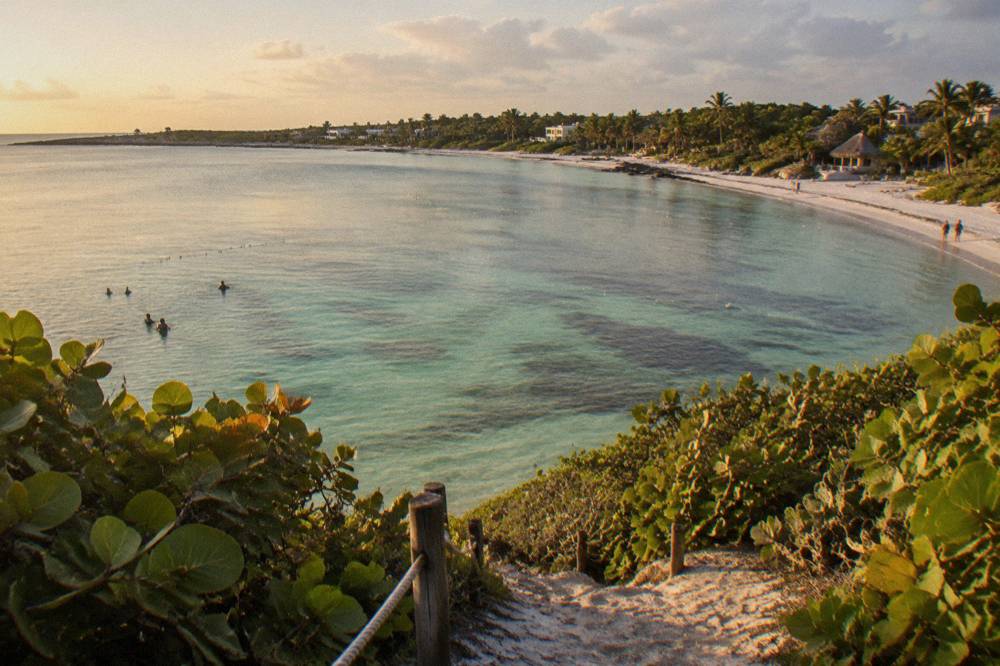
Nesting data backs up how central this stretch of coast is for the species. The 2026 season closed in September with 922 nests recorded across the monitored beaches, 747 from green turtles and 175 from loggerheads, a medium-high season below the historic 1,350. Within that, Bahia Akumal itself logged 345 green nests and 55 loggerhead nests. Nesting on the Xcacel-Xcacelito subpolygon runs 1 May to 30 November, which overlaps with the courtship and mating period, April to November, when the refuge is kept free of swimming, recreation and boats at night precisely because the turtles are using it.
That is the deeper answer to the friendliness question. The turtles are not friendly in the sense of seeking people out. They are present, habituated to respectful distance, and protected by a rules regime that keeps their feeding and breeding schedule intact. When a visitor follows the 3 m rule, they are not just being polite, they are participating in the management plan that keeps a wild population grazing a few meters from a public beach.
How Close Can You Get To A Sea Turtle?
The published minimum is 3 m, and the time limit is 2 minutes of watching any one turtle. A guide will hold the group at that distance and let the turtle close the gap if it chooses, which is the only version of a close encounter that the rules allow and the only one the turtle consented to.
Three meters feels far on land and close in water. A green turtle with a shell the length of a carry-on suitcase, gliding under you at three meters, fills a good part of your view, and with a mask on there is no sense of missing anything. The problems start when snorkelers kick hard to shrink the gap, pass in front of a surfacing animal, or hover directly above it so it cannot rise to breathe. Blocking a turtle's path to the surface is one of the fastest ways to turn a calm grazer into a departing one.
Photography is where the pressure to break the distance rule builds, and it is why the GoPro-included tours are a genuinely smart choice for temperament rather than convenience. When the guide carries the camera, the guest's only job is to float and be patient, and the album arrives regardless of whether anyone got near the animal. The private line from Akumal Mayan VIP Tours, Swim with Turtles in Akumal plus a GoPro photo session, from $50, rated a perfect 5.0 from 303 reviews, works this way, with a personal certified guide and the photo session in the listed inclusions.
The same math applies to families with camera-happy teenagers and to nervous first-timers. The tour removes the temptation, the guide models the distance, and the turtle sets the pace. Anyone who wants the fuller planning picture, including what to wear and what to leave at the hotel, can pick it up in the what to bring guide, while the swim with turtles guide walks through the water skills side, useful for anyone still deciding whether the bay suits their swimming.
Guided Tours And Turtle Etiquette
A certified guide is compulsory for tourist swimming inside the buoyed turtle circuits, where groups run at a maximum of six snorkelers plus the guide between 9:00 and 17:00. Outside the circuits, an independent snorkeler in the bay is covered by CEA guidance that treats the vest as advisable and the conduct code as the same.
This distinction is the single most misunderstood thing about Akumal, so it deserves its own space once. The federal programme governs the circuits: certified guide, mask and snorkel, short fins, immersion-preventing vest, group cap, time slots, daily caps. The CEA guidance governs behavior everywhere in the bay: the 3 m distance, the 2 minute rule, no touching, no chasing, stay horizontal. A snorkeler who quotes one to dodge the other is misquoting both, and a good guide explains the boundary on the beach before anyone gets wet.
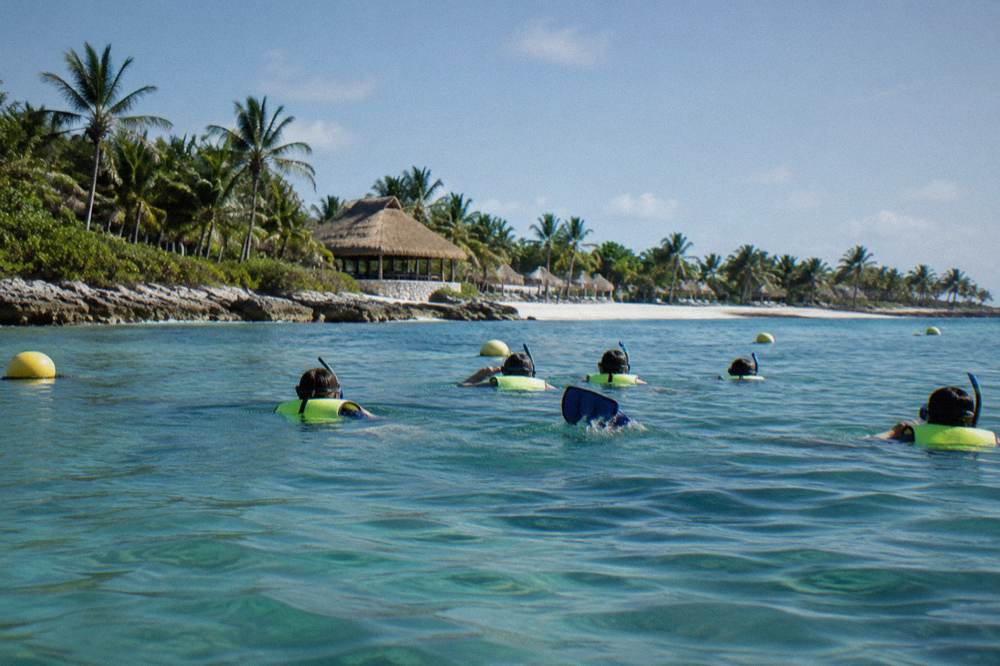
For choosing among the tours, the differences that matter for turtle etiquette are format and inclusions rather than price. The listings compared here run from local group lines around the low $30s per person to private lines and full cenote combo days, and each handles the etiquette burden the same way, through the guide:
| Tour line | From (as listed) | Rating and reviews | What it adds to etiquette |
|---|---|---|---|
| Swim with sea turtles, Akumal Ecological Guides | $45 per person | 4.6 from 454 reviews | Most reviewed listing, guide plus entry handled |
| Akumal Beach VIP snorkeling with GoPro photos | $34 per person | 4.6 from 410 reviews | Guide takes photos, no pressure to approach |
| Turtle Snorkeling at Natural Paradise, Amigo Tours | $45 per person | 4.4 from 9 reviews | Park entry, facilities and certified guide included |
| Private snorkeling with sea turtles, Akumal Mayan VIP Tours | from $50 | 5.0 from 303 reviews | One guide, one group, unhurried pace |
The VIP GoPro line from Akumal Mayan Trips deserves a specific mention for nervous swimmers, because its inclusions, wristband admission to the natural park, access to the protected circuit, a licensed local guide, gear and a life jacket, bundle everything the rules demand into one price from $34 per person. There is nothing left to get wrong at the gate. The cenote combo days, such as the Cancun small-group turtle and cave cenote adventure from $80 per person plus a US$20 marine tax and a US$15 operation fee as the listing states it, add a second ecosystem to the day but run the turtle segment under the identical circuit rules.
Rest periods are one timing wrinkle worth knowing. One report describes two annual rest periods for the turtle circuits, including September, under Semarnat environmental permits. Treat that as reported, and confirm the current schedule with the operator when booking, because rest windows shift and no listing here promises otherwise. More on choosing by month sits in the best month guide.
When Turtles Prefer To Be Left Alone
The refuge closes to swimming, recreation and boats at night, because turtles court and mate in the bay from April to November, and nesting females come ashore on the region's beaches from 1 May to 30 November. Those are the periods when respectful distance matters most, and no tour listed here operates at night.
A turtle grazing in the morning is a different animal from a turtle mid-courtship. Mating pairs and nesting females are spending energy reserves they cannot easily replace, and the federal rules respond by clearing the water after dark rather than by asking individuals to self-police. Daytime snorkelers inherit a simpler version of the same principle: read the animal, not the clock. A turtle swimming steadily along is viewable from your 3 m. A turtle hovering to rest on the bottom, or surfacing repeatedly in one spot, is working, and the kindest move is the 2 minute watch and a slow drift elsewhere.
The 2026 nesting season numbers show how much of the year the turtles are using this coast for reproduction rather than for tourist viewing. Nine hundred twenty-two nests closed the season, with green turtles accounting for 747 of them, concentrated at Bahia Akumal with 345 nests. Every one of those hatchlings' mothers came up a beach at night while the water sat empty of snorkelers, which is the system working exactly as designed.
Akumal's turtles are not friendly, and they are not unfriendly. They are wild animals that have been given a protected home, a strict set of visitor rules and a daily rhythm that leaves them room to be turtles, and in return they go on tolerating a floating audience. Every tour listed here, from the $33 small-group line to the $260 private cenote day, is a way of buying into that bargain with a guide holding your side of it. More context on the town and beach around the bay is in the things to do in Akumal roundup, and the full tour comparison on the homepage carries the complete list of guides for anyone still weighing formats.
Common Questions About Sea Turtle Friendliness
Are Sea Turtles Friendly? What Happens In The Water
They are wild animals that tolerate calm snorkelers at a distance. A green turtle keeps grazing while you float 3 m away and leaves if you crowd it. No source for the bay records a bite or attack, and the rules exist to keep it that way.
Do Sea Turtles In Akumal Bite People?
No source for Akumal Bay describes a turtle biting a snorkeler. Greens are herbivores, loggerheads crush shellfish and hawksbills eat sponges, none treat people as prey. The documented risk is harm flowing the other way, through touching, chasing or blocking.
How Close Can I Swim To A Turtle?
At least 3 m, and never close the gap yourself. The Centro Ecologico Akumal also asks snorkelers to watch any single turtle for no more than 2 minutes. If the turtle approaches you, stay still and let it pass.
Can I Touch Or Feed A Sea Turtle In Akumal?
No. The federal protection programme prohibits touching, feeding, chasing, harassing or removing wildlife, and prohibits standing on coral. Feeding teaches turtles to approach boats and people, which endangers them.
Do I Need A Guide To Swim With The Turtles?
Inside the buoyed turtle circuits, yes, tourist swimming requires a certified guide, short fins and an immersion-preventing vest under the federal programme. Outside the circuits, CEA guidance for independent snorkelers treats a vest as advisable, though the conduct code, 3 m, 2 minutes, no touching, still applies.
What Time Of Day Are Turtles Most Relaxed?
Operators report calmer water and fewer crowds early, before the day-tripper window, and the circuits open at 9:00. Morning slots tend to mean fewer groups per turtle, which keeps encounters slow and short on everyone's terms.