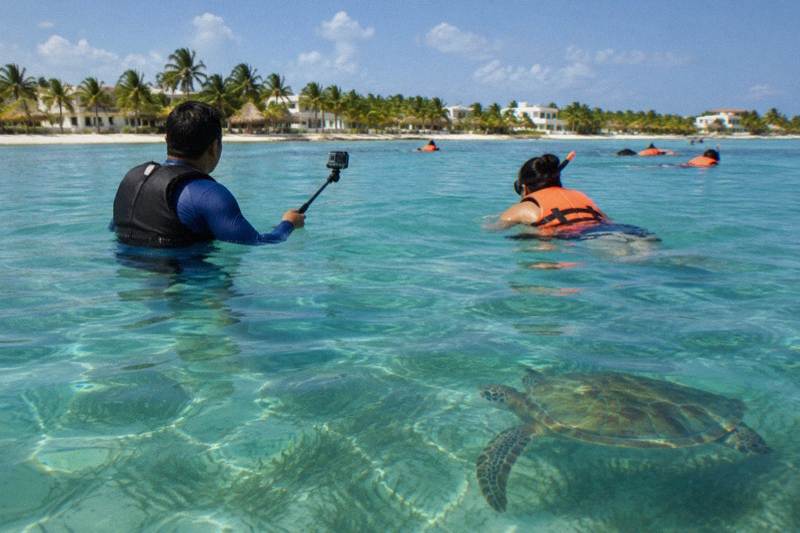
Half Moon Bay Akumal: Calm Water Next To The Turtle Bay
Half Moon Bay is the quieter crescent immediately north of Akumal Bay, and it answers a specific question travelers ask after seeing the crowds inside the turtle circuits: is there calmer water within walking distance?
Short answer
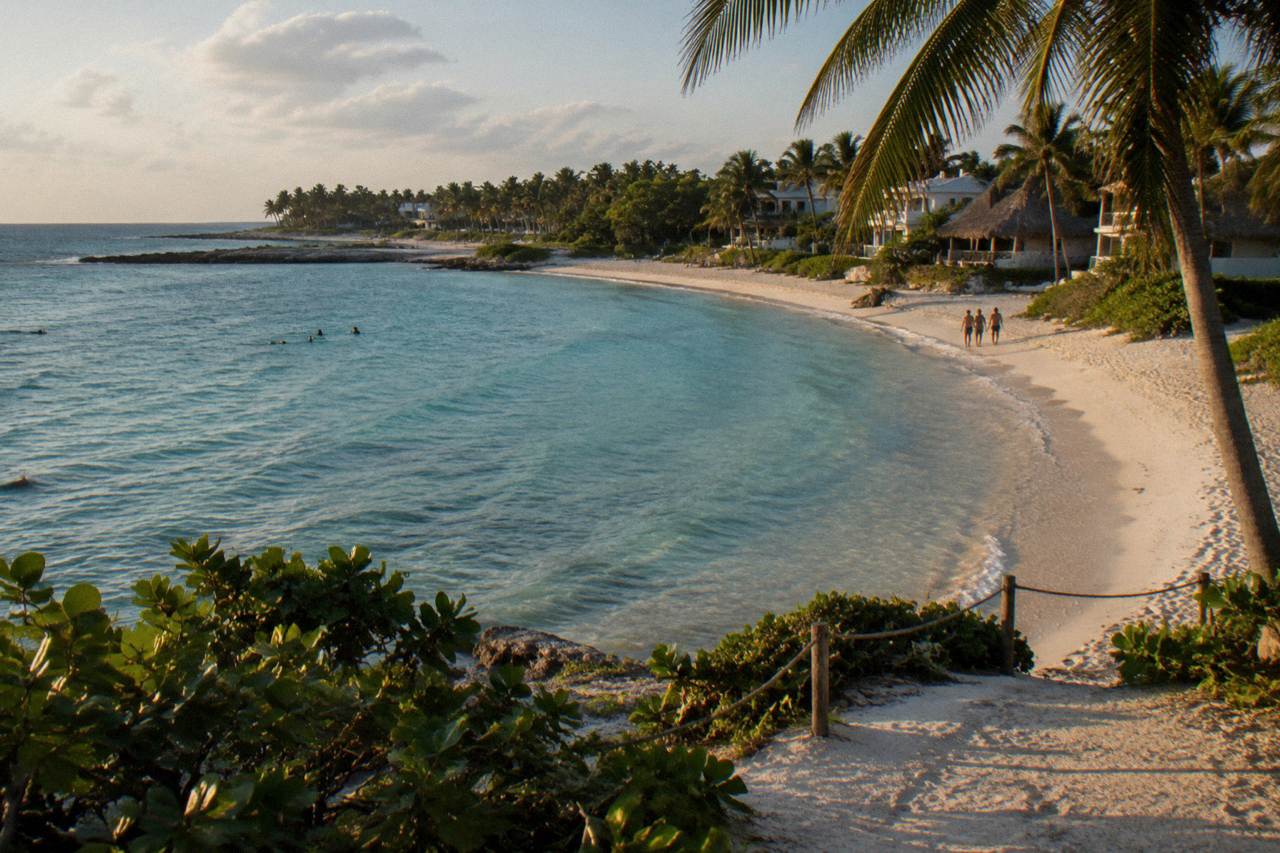
Half Moon Bay, locally Bahia Media Luna, is a coastal stretch just north of Akumal Bay, reported by an October 2026 travel source as a quieter spot suited to swimming. The buoyed turtle circuits sit in Akumal Bay only, so guided turtle swims leave from next door, while 2026 monitoring recorded 12 green and 14 loggerhead nests on Half Moon Bay's sand.
Half Moon Bay curves north of Akumal Bay like its name suggests, a crescent of pale sand and shallow water that travel coverage describes as a quieter stretch suited to swimming and snorkeling. That single reported line matters because most visitors arrive with a plan built entirely around the turtle circuits one bay south, where a federal protection program caps daily visitors and sends group after group through on a timed rotation. The result is a natural question this guide answers directly: what is Half Moon Bay actually for, if the turtles are formally watched next door?
The answer has three parts. First, Half Moon Bay is a real, walkable alternative when Akumal Bay feels busy, with water reported as calmer and a shoreline without a formal park gate in front of it. Second, the regulated turtle experience does not move: the buoyed circuits, the certified guides and the daily caps all live in Akumal Bay, which is why the tours compared here, from the VIP GoPro line of Akumal Mayan Trips to the small-group photo tours of We Love Akumal, all launch from there. Third, Half Moon Bay is not turtle-free: monitoring cited by the Centro Ecologico Akumal counted 12 green turtle and 14 loggerhead nests on this stretch of sand in the 2026 season, a modest share of the 922 nests recorded across the area's beaches.
This guide walks through location, water conditions, the turtle question, tour pairing, costs and timing, with each section written to stand alone. Readers planning the whole morning may also want the broader Akumal Bay turtle snorkeling guide, which covers the circuits in detail.
Where Is Half Moon Bay In Akumal?
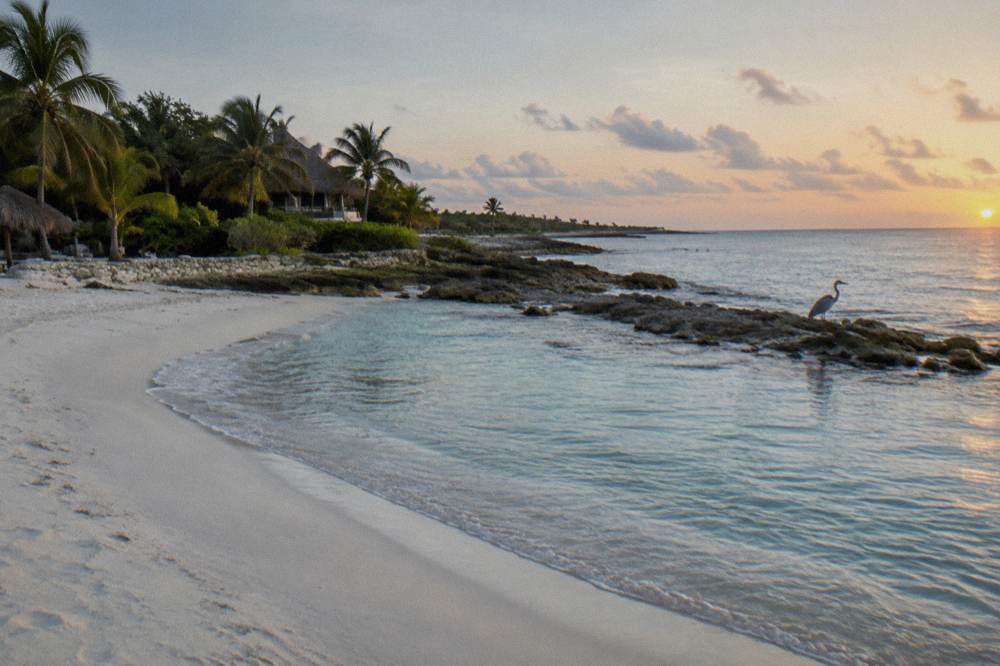
Half Moon Bay, or Bahia Media Luna in Spanish, is the crescent-shaped bay immediately north of Akumal Bay on the Riviera Maya coast, sitting just north of the main turtle bay on the local stretch of coastline that also includes Yal-Ku Lagoon further north. No official source publishes an access route, gate or fee schedule for Half Moon Bay itself, so this guide makes no access or fee claim for it: the geography is settled, and the bay's position and role are what matter here. Travelers staying in Akumal Pueblo or near the arch at the main beach entrance reach it without a vehicle, which is the practical reason it fills the "calm alternative" role so well.
The name is literal. The bay sweeps in a half-moon arc between rocky points, and travel coverage describes it as a quieter coastal stretch suited to swimming and snorkeling, a reputation repeated across local coverage of the area. What that source does not do, and what no official page consulted here does either, is publish formal rules for the bay. That gap shapes everything else in this guide: regulations exist for Akumal Bay's circuits, published in the federal Diario Oficial program and on the Centro Ecologico Akumal's own pages, while Half Moon Bay sits outside those documents.
One food landmark anchors the bay for orientation: La Lunita, a seafood and Mexican restaurant on Half Moon Bay, appears in local recommendations for the area. It is a useful meeting point when describing the walk north from the main bay.
| Fact | What Is Confirmed |
|---|---|
| Location | Immediately north of Akumal Bay, Riviera Maya coastline |
| Local name | Bahia Media Luna |
| Character | Quieter stretch suited to swimming, per travel coverage (reported) |
| Official access details | Not found in official sources; no access or fee claim made |
| Turtle circuits | In Akumal Bay only, not in Half Moon Bay |
| Landmark | La Lunita restaurant on the waterfront (locally recommended) |
For context on the wider shoreline, the Yal-Ku Lagoon or Akumal Bay comparison covers the lagoon another stretch north, and the general snorkeling in Akumal guide maps the whole area for first-time visitors.
How Calm Is The Water At Half Moon Bay?
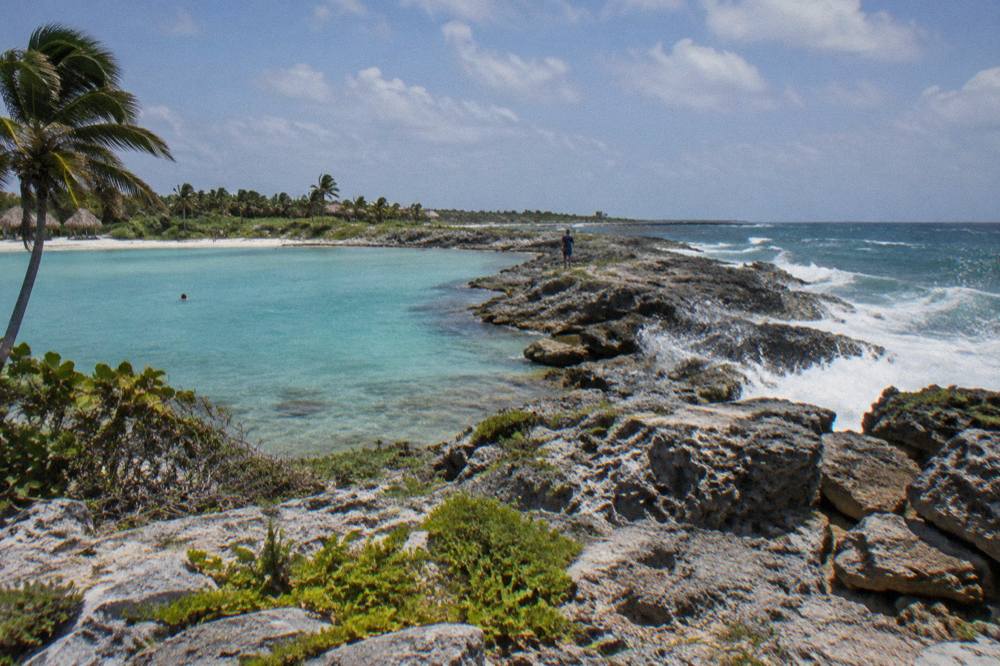
Travel sources describe Half Moon Bay as calmer and quieter than Akumal Bay, with the crescent shape and rocky points reported to buffer the water, though no source publishes measured conditions, and like every open Caribbean bay it is exposed to wind, weather and sargassum, which change daily and by season. The calm reputation is reported, not guaranteed. What can be said is reported, not measured: one local source describes it as the quieter option when the main bay chops up or fills with day-trippers.
That said, sargassum does not respect reputations. The satellite monitor of the Observatorio Ciudadano del Sargazo, in its last clear image of 12 October 2026, showed sargassum or brown tide at all ten Akumal-area beaches, and identified Bahia Media Luna as one of the three worst affected that day, alongside Playa Aventuras and Xcacel. Five days later the same monitor could not observe any of the ten beaches at all because of complete cloud cover. That is the picture: seaweed here is a daily status published by monitors, not a monthly norm, and a bay reported as calm in one week can carry sargassum the next. The seaweed situation in Akumal is covered in its own article.
Conditions also improve with the clock. Local operators and guides consistently point to early morning, before roughly 09:00 or 10:00, as the calmest window on this whole stretch of coast, before day-tripper boats and afternoon winds arrive. That advice applies to both bays equally and is the single most repeated practical tip in the sources behind this guide.
| Condition Factor | Half Moon Bay (Reported) | What It Means For Planning |
|---|---|---|
| General calm | Described as quieter and suited to swimming, one source | A credible calm alternative, not a promise |
| Shape | Crescent between rocky points | Reported to buffer wind and wave energy |
| Sargassum | Worst-affected beach in the 12 October 2026 clear satellite image | Check a daily monitor, never assume |
| Time of day | Early morning flagged as calmest coast-wide | Arrive before 09:00 for the best water |
| Measured figures | None published in official sources | No depth, visibility or clarity claims made here |
The practical takeaway for a snorkeler is simple: Half Moon Bay is a legitimate plan B and a pleasant swim in its own right, but the turtle experience it sits next to is the reason most people are on this coast at all. Readers who want that experience with a trained eye on conditions often book the guided options, and three of the most useful stand out.
Can You See Turtles At Half Moon Bay Or Only In Akumal Bay?
The regulated turtle-swim circuits exist only in Akumal Bay: the federal protection program for the Bahia de Akumal refuge allows turtle observation swimming solely in Circuit 1 and Circuit 2, marked with buoys, so the guided turtle tours in the guide index run there, not in Half Moon Bay. That is the legal geography, published in the Diario Oficial program of 2017, which also fixes the rules inside those circuits: a certified and authorized guide, a mask, snorkel, short fins and a life jacket that prevents total immersion, groups of at most six people plus the guide, and hours of 09:00 to 17:00, with Circuit 1 capped at 256 people per day and maximum stays of 55 minutes per group and Circuit 2 at 300 people per day and maximum stays of 65 minutes per group. The Centro Ecologico Akumal publishes the program's visitor-facing rules on its snorkeling guidelines page.
None of that machinery exists at Half Moon Bay. No buoys, no circuits, no daily caps published in a federal document. And yet turtles are not strangers to the crescent: the bay's sand is a monitored nesting beach. In the 2026 season, reported by Riviera Maya News quoting the CEA director, Bahia Media Luna recorded 12 green turtle nests and 14 loggerhead nests, a small fraction of the area's 922-nest season total. For scale, the main Bahia Akumal beach carried 345 green and 55 loggerhead nests, and Playa Tortuga led the loggerhead count with 78. Readers can see the full season-closing nest report as published.
Nesting turtles are a different thing from swimming turtles, and the distinction matters. Nesting happens at night on the sand, from a season that runs 1 May to 30 November on the Xcacel-Xcacelito subpolygon, and the refuge is kept free of swimming, recreation and boats at night in part because turtles court and mate in these waters from April to November. Operators describe resident green turtles feeding on seagrass in Akumal Bay all year, described as the norm rather than the exception, but no sighting is ever promised here: turtles, fish and water clarity are wild variables.
| 2026 Nesting Beach | Green Nests | Loggerhead Nests |
|---|---|---|
| Bahia Akumal (main bay) | 345 | 55 |
| Playa Tortuga | 261 | 78 |
| Akumal Sur | 129 | 28 |
| Bahia Media Luna (Half Moon Bay) | 12 | 14 |
| Season total, all area beaches | 747 | 175 |

Because the circuits live next door, the standard pattern for visitors is a guided turtle swim in Akumal Bay followed by free time, and the bay-hopping logic works best when the tour builds the free time in. The half-day beach experience from NS Vacations Tours does exactly that: a guided turtle encounter with an aquatic guide, snorkel gear, snacks and bottled water, then two hours of free beach time, from $83 per person, with a US$15 per person government fee payable separately as the listing states it, rated 4.5 from 99 reviews. The beach time is unprogrammed, which is precisely when a walk north to the crescent fits.
Do Any Akumal Turtle Tours Stop At Half Moon Bay?
No listing here names Half Moon Bay as a tour stop: the turtle tours compared here operate in Akumal Bay's circuits, and the listings that mention free beach time leave it unstructured, so Half Moon Bay functions as a do-it-yourself add-on before or after a guided swim rather than a stop on an operator's itinerary. That is not a weakness of the bay, it is a consequence of the regulation: since turtle observation swimming is only permitted inside the two buoyed circuits, an operator's product is anchored there, and beach time, where offered, is explicitly free time rather than a guided second stop.
The pairing logic still works well. A traveler books a short circuit tour, such as the VIP swim with turtles from Akumal Mayan Trips, which includes wristband admission to the natural park, access to the protected turtle circuit, a local licensed guide, mask, snorkel, life jacket and GoPro photos, from $34 per person, rated 4.6 from 410 reviews. The circuit session runs about an hour and a half door to door. With the rest of the morning free, the walk north to the crescent is a natural cooldown.
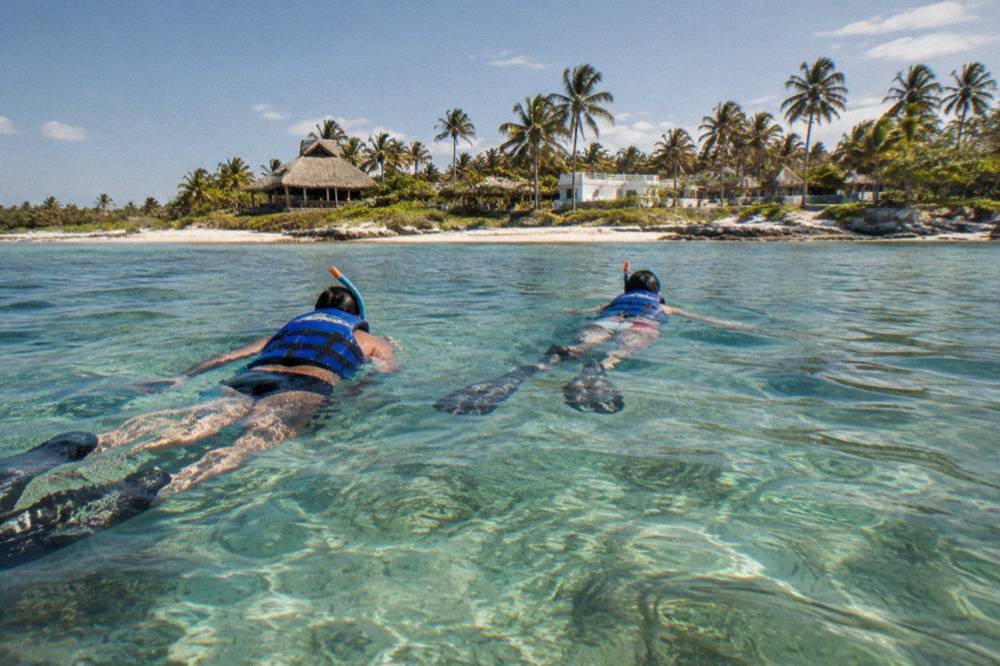
The small-group alternative changes the rhythm rather than the geography. We Love Akumal's Snorkeling and Photos with Turtles runs 1 hour 10 minutes from $33 per person, rated 4.9 from 216 reviews, with gear, vest, access to the protected turtle area and a GoPro photo album included, though its listing notes extras such as parking, a private beach access bracelet at 140 pesos or 9 USD, and digital lockers at 100 MXN payable by card. Shorter still, the VIP GoPro session from Akumal Mayan VIP Tours is a private, one-hour swim rated 5.0 from 303 reviews, from $50. Each leaves most of the day open, which is the real argument for building a two-bay morning.
A word on what the listings do not say. Several lines here share operators while remaining genuinely different products, and inclusions do not transfer between them: pickup, meals and fee lines are printed as each listing states them or not at all. Checking the operator's live listing for what a specific tour includes remains the reliable move, and the same applies to cancellation windows, which vary by listing.
What Does It Cost To Visit Half Moon Bay?
No official source publishes an entry fee or access charge for Half Moon Bay itself, so this guide prints no fee figure for it, while the costs that can be stated with confidence sit next door: Tsuuk Akumal Natural Park, the convenient beachside entry point to the main bay area, charges US$7 per person for foreign visitors and MXN 130 for Mexican nationals, per its official services page. The park ticket is a beach and facilities entry, not a tour: it covers wristband identification, restrooms, showers, changing rooms, lockers with a refundable MXN 100 deposit, lifeguards and umbrellas or chairs subject to availability, and the park itself does not run turtle tours or rent vests, as its own services page states.
Akumal Beach itself is a public federal beach with free access, as multiple 2026 sources report, with the park entry being the convenient route that bundles facilities. Both facts are true at once and both are stated here, scoped: the sand and the shallows outside protected zones are free to walk and swim; the wristband buys the serviced access. Quintana Roo residents enter the park free without services, and children under 5, INAPAM seniors and visitors with disabilities enter free with services. The full index of guides sits on the guide index.
Around the visit, the reported incidental costs add up modestly. Parking at the main day-use lots runs about MXN 100 per day, reported, or MXN 40 an hour at Plaza Ukana inside the arch area. A colectivo shared van from Playa del Carmen or Tulum costs a reported 40 to 50 MXN. A private transfer from Cancun airport is listed at US$105 one way for a van up to eight passengers on an operator page. Tips for guides, where earned, are reported in local guides as a cash norm of roughly 5 to 10 USD per person for good service.
| Cost Item | Figure | Basis |
|---|---|---|
| Half Moon Bay entry | No confirmed figure; no fee claim made | Not found in official sources |
| Tsuuk Akumal park entry, foreign visitors | US$7 per person | Official park page |
| Tsuuk Akumal park entry, Mexican nationals | MXN 130 per person | Official park page |
| Main beach access | Free, public federal beach | Reported, multiple 2026 sources |
| Parking near the main entrance | About MXN 100 per day | Reported |
| Colectivo from Playa del Carmen or Tulum | 40 to 50 MXN | Reported |
| Guide tip norm | About 5 to 10 USD per person | Reported in local guides |
The tour layer sits on top of the access layer. Group and small-group turtle tours on the guide index run from $32 to $46 per person for the short Akumal-based lines, private lines run from $43 to $260 as each listing states its basis, and full cenote-combo days from Cancun or the Riviera Maya reach $109 per person, with some lines carrying extra fee lines of US$15 to $40 per person payable separately, quoted exactly as the listings state them. The full price landscape is broken down in the Akumal snorkeling cost guide.
When Is The Best Time Of Day For Half Moon Bay?
Early morning, roughly 07:00 to 10:00, is the window local operators and guides consistently recommend for this whole stretch of coast, reported as the calmest water, the fewest crowds and the most comfortable temperatures, before day-trippers from Playa del Carmen and Cancun arrive and before afternoon winds pick up the surface. The same sources flag the period before 09:00 or 10:00 specifically, which lines up neatly with the federal circuit hours in Akumal Bay: tours inside the turtle circuits run 09:00 to 17:00, so a very early arrival at Half Moon Bay for a swim, followed by a first-slot guided circuit next door, uses the coast at its best on both counts.
Season shapes the crowd picture more than the clock does. High season runs late December to early April, reported by one local source, with low season late June to September and shoulder windows in between. October sits in a quiet shoulder, one guide notes, with a short late-month spike around Day of the Dead. Hurricane season officially runs 1 June to 30 November per NOAA, and as of early October 2026, eight named Atlantic storms had been recorded with none reaching hurricane strength or threatening Quintana Roo, a status worth checking rather than assuming for any future date.
One scheduling wrinkle deserves a flag rather than a promise. One scheduling wrinkle is worth flagging: a single source, Riviera Maya News in late August 2026, reported two annual Semarnat rest periods for the turtle circuits, including September, under which turtle swim tours pause, so it is worth confirming with the operator when booking rather than assuming any given date. Beyond that, a sea-temperature dataset puts October water near 29 C, though datasets describe averages, not the morning a reader actually swims.
For readers converting that timing advice into a booking, platform averages cited in 2026 listings show travelers booking roughly 12 to 45 days ahead, with one operator noting 2 to 3 weeks for the December-to-April peak. The early circuit slots are the scarce commodity; the calm crescent next door is not.
How Does Half Moon Bay Compare With Akumal Bay And Yal-Ku Lagoon?
Half Moon Bay, Akumal Bay and Yal-Ku Lagoon form a three-stop stretch of coast within minutes of each other: Akumal Bay holds the regulated turtle circuits and the busiest sand, Half Moon Bay is the reported-calm crescent with no published access rules, and Yal-Ku is a paid lagoon, about US$20 or 300 MXN on the Xcaret-operated side, where vests are mandatory and chemical-free sunscreen is required. Choosing among them is mostly a choice of what the morning is for: turtles with a guide, quiet swimming, or fish in a still lagoon.
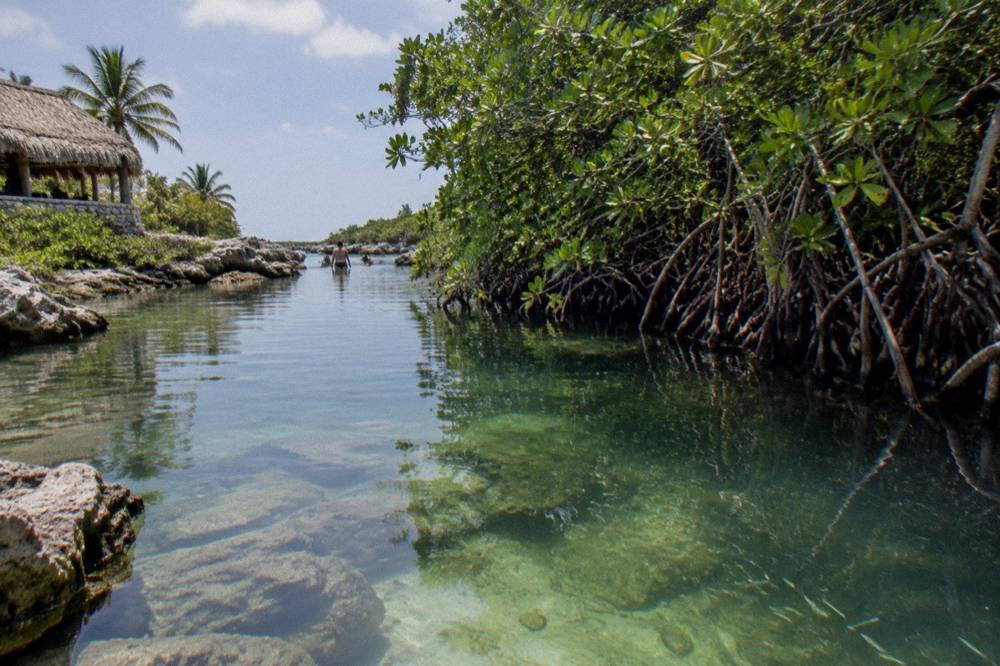
The comparison lays out the trade-offs plainly. Yal-Ku's rules are published by its operator: hours 9:00 to 17:00, mandatory life vests on the Xcaret side, chemical-free sunscreen, and bans on coolers, food, drinks, inflatables and pets. Half Moon Bay has no equivalent published rule set in the sources here, which cuts both ways: freedom, but no lifeguard or facility claims either. Akumal Bay, through the park entry, bundles lifeguards, showers and lockers into the wristband. Water character differs too: the lagoon is still by nature, the main bay is open Caribbean, and the crescent sits in between, reported calmer than the main bay but exposed like any open coast.
| Feature | Akumal Bay | Half Moon Bay | Yal-Ku Lagoon |
|---|---|---|---|
| Turtle swim circuits | Yes, Circuits 1 and 2 only | No | No |
| Entry | US$7 foreign / MXN 130 via park; beach itself public and free | No confirmed figure | About US$20 or 300 MXN, Xcaret-operated side, reported |
| Water character | Open bay, seagrass beds | Reported calm crescent | Still lagoon |
| Published rules | Federal program plus CEA code of conduct | None found in official sources | Vest mandatory, chemical-free sunscreen, no food or inflatables |
| Facilities | Restrooms, showers, lockers, lifeguards via park entry | Not confirmed | Operator-run site, 9:00 to 17:00 |
| 2026 nests on its sand | 345 green, 55 loggerhead | 12 green, 14 loggerhead | Not a nesting beach in the report |
Snorkelers weighing fish against turtles sometimes split the morning: a circuit tour in Akumal Bay, then Yal-Ku for color. One line covers the turtle half in one go, the GoPro shoot line from Nado con tortugas akumal guias locales, a private turtle snorkel in Akumal Bay, 1 hour 15 minutes from $46 per person, rated 4.8 from 41 reviews, including gear, government fees and a photo shoot in and out of the water, sea conditions permitting. It is a reminder that the coast's three water experiences are close enough to combine, and the detailed lagoon-versus-bay breakdown lives in the Yal-Ku or Akumal Bay guide.
What Should You Know Before Walking Between The Two Bays?
The walk between the two bays is short and waterfront, but a few set rules travel with you: the Centro Ecologico Akumal's code of conduct asks snorkelers to stay inside the bay they are in, stay horizontal on the surface, never stand on reef, never touch or chase turtles, keep at least 3 m from any turtle, watch a single turtle no more than 2 minutes, and wear a sun-shirt or biodegradable sunscreen. The sunscreen point carries federal weight in the main bay: the protection program allows only biodegradable sunscreen in the Bahia de Akumal subpolygon, and no brand is named as approved anywhere here, so the label has to say biodegradable and the safest move is a rash guard.
The turtle-specific etiquette is worth restating because it is the part visitors most often get wrong in the excitement of a sighting. No touching, feeding, chasing, harassing or removing wildlife, and no standing on coral, are prohibitions in the federal program, not suggestions. The three-meter distance and two-minute watch come from the CEA's published guidelines. At night the refuge is kept free of swimming and boats, because turtles court and mate in these waters from April to November, so the wildlife calendar is active even when the nesting sand looks empty.
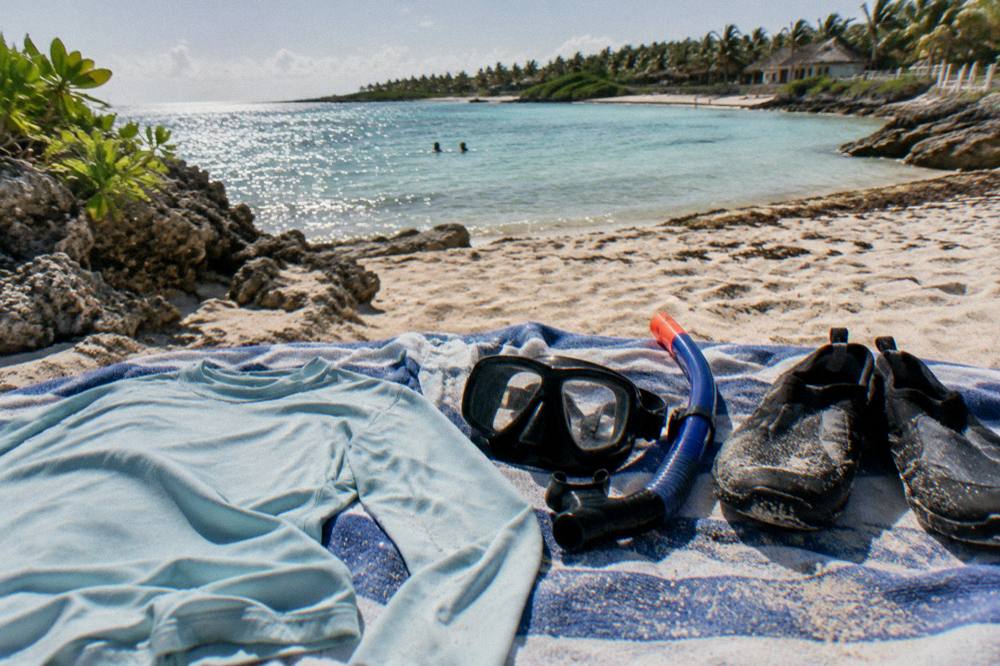
Practical layering completes the picture. A sun shirt beats sunscreen for a long session. Cash in pesos covers parking, colectivos, lockers and tips, since at least one listing's lockers are card-only while parking lots are cash. Water shoes help at both bays' entries, and the packing details are laid out in the what to bring for Akumal snorkeling guide. Readers with nervous swimmers in the group should also read whether a non-swimmer can snorkel in Akumal, since the vest rules inside the circuits change that answer considerably.
Which Tour Fits A Half Moon Bay Morning?
For most readers the answer is a short, well-rated Akumal Bay circuit tour with the rest of the morning left open: the VIP GoPro line from Akumal Mayan Trips at from $34 per person, 4.6 from 410 reviews, or the small-group photo tour from We Love Akumal at from $33 per person, 4.9 from 216 reviews, both under two hours, both leaving time to walk north and swim the crescent afterward. Travelers who want the logistics handled instead, transport, snacks and structured free time, suit the half-day beach experience from NS Vacations Tours, from $83 per person plus a US$15 per person government fee payable separately, rated 4.5 from 99 reviews, departing from Playa del Carmen.
The choice among them is a choice of texture, not quality. The VIP line carries the biggest review pool of these options at 410 reviews: park wristband, protected circuit, licensed local guide, gear and GoPro photos in the price, with lockers the stated exclusion. The small-group line is the reviewers' favorite on this stretch, 4.9 across a substantial pool of 216 reviews, and its stated extras, the private beach bracelet and card-only digital lockers, are small cash items to anticipate. The half-day adds the vehicle, the snacks and two hours of unstructured beach time, which is the version that most naturally becomes a two-bay morning without any planning effort.
Cancellation is the quiet variable worth checking at booking time. Most listings here offer free cancellation up to 24 hours before start, some private or operator-run options require 48, and policies sit on each operator's live listing rather than in any general rule. Weather flexibility matters on this coast: a morning that starts with sargassum at the crescent can still deliver a calm circuit swim, and vice versa, so keeping one movable plan beats committing to a single bay.
Common Questions About Half Moon Bay Akumal
Where Is Half Moon Bay In Akumal?
Half Moon Bay, Bahia Media Luna, is the crescent-shaped bay immediately north of Akumal Bay on the Riviera Maya coast, a short waterfront walk from the main bay's entrance area. No official source publishes an access route or fee for it, so this guide claims none.
Can You See Turtles At Half Moon Bay?
The regulated turtle-swim circuits are in Akumal Bay only, so guided turtle tours do not run at Half Moon Bay. The crescent's sand is a nesting beach, with 12 green and 14 loggerhead nests recorded there in the 2026 season, but nesting happens at night and no sighting of a swimming turtle is ever promised anywhere on this coast.
Is Half Moon Bay Calmer Than Akumal Bay?
Travel sources report it as a quieter stretch suited to swimming, and its shape is described as buffering wind and waves, but no source publishes measured conditions. Like every open Caribbean bay it is exposed to wind, weather and sargassum, which change daily; the 12 October 2026 satellite image actually showed it among the area's worst-affected beaches that day.
Do Turtle Tours Stop At Half Moon Bay?
No listing among the tours compared here names Half Moon Bay as a stop. Tours operate in Akumal Bay's buoyed circuits, and listings that include free beach time, such as the half-day experience with two hours of free time, leave that time unstructured, which is when a walk north to the crescent fits.
How Much Does It Cost To Visit Half Moon Bay?
No confirmed fee figure exists for Half Moon Bay itself. The costs around it are clearer: Akumal Beach is a public federal beach with free access, the convenient Tsuuk Akumal park entry is US$7 per person for foreign visitors or MXN 130 for Mexican nationals, and parking runs a reported MXN 100 per day at the main lots.
When Is The Best Time To Go To Half Moon Bay?
Early morning, roughly 07:00 to 10:00, is the window local guides consistently recommend across this coast, reported as the calmest water and fewest crowds. High season runs late December to early April, reported by one source, and October sits in a quiet shoulder with a brief late-month uptick around Day of the Dead.